Fixing UMI Problems
Correcting misaligned V-segment primers and indels in UMI groups
Before generating a consensus for a set of reads sharing a UMI barcode, the sequences must be properly aligned. Sequences may not be aligned if more than one PCR primer is identified in a UMI read group - leading to variations in the the start positions of the reads. Ideally, each set of reads originating from a single mRNA molecule should be amplified with the same primer. However, different primers in the multiplex pool may be incorporated into the same UMI read group during amplification if the primers are sufficiently similar.
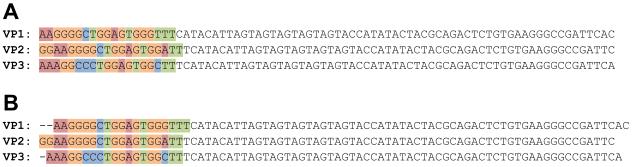
Correction of misaligned sequences. (A) Discrepancies in the location of primer binding (colored bases, with primer name indicated to the left) may cause misalignment of sequences sharing a UMI. (B) Following multiple alignment of the reads the non-primer regions are correctly aligned and suitable for UMI consensus generation.
This type of primer misalignment can be corrected using one of two approaches
using the AlignSets tool. The first approach, which is conceptually
simpler but computationally more expensive, is to perform a full multiple
alignment of reach UMI read group using the muscle subcommand of
AlignSets. The --bf BARCODE argument tells
AlignSets to multiple align reads sharing the same BARCODE annotation.
The --exec ~/bin/muscle is a pointer to
where the MUSCLE executable is located:
AlignSets.py muscle -s reads.fastq --bf BARCODE --exec ~/bin/muscle
The above approach will also insert gaps into the sequences where an
insertion/deletion has occured in the reads. As such, you will need to provide
as reasonable gap character threshold to BuildConsensus, such as
--maxgap 0.5, defining how you want to handle
positions with gap characters when generating a UMI consensus sequence.
Note
Using the muscle subcommand, along with the
--maxgap argument to BuildConsensus
will also address issue with insertions/deletions in UMI read groups.
Though, in UMI read groups with a sufficient number of reads consensus generation
will resolve insertions/deletions without the need for multiple alignment,
as any misaligned reads will simply be washed out by the majority.
Whether to perform a multiple alignment prior to consensus generation is a
matter of taste. A multiple alignment may improve consensus quality in
small UMI read groups (eg, less than 4 sequences), but the extent to which
small UMI read groups should be trusted is debatable.
The second approach will correct only the primer regions and will not address insertions/deletions within the sequence, but is much quicker to perform. The first step involves creation of a primer offset table using the table subcommand of AlignSets:
AlignSets.py table -p primers.fasta --exec ~/bin/muscle
Which performs a multiple alignment on sequences in primers.fasta
(sequences shown in the primer alignment figure above)
to generate a file containing a primer offset table:
primers_offsets-forward.tab¶VP1 2
VP2 0
VP3 1
Then the offset table can be input into the offset subcommand of AlignSets to align the reads:
AlignSets.py offset -s reads.fastq -d primers_offsets-forward.tab \
    --bf BARCODE --pr VPRIMER --mode pad
In the above command we have specified the field containing the primer annotation
using --pr VPRIMER and set the behavior
of the tool to add gap characters to align the reads with the
--mode pad argument.
These options will generate the correction shown in (B) of the
primer alignment figure above. Alternatively,
we could have deleted unalign positions using the argument
--mode cut.
Note
You may need to alter how the offset table is generated if you have used the
--mode cut argument to MaskPrimers
rather than --mode mask, as this will
cause the ends of the primer regions, rather than the front, to be the
cause of the ragged edges within the UMI read groups. For primers that
have been cut you would add the --reverse
argument to the table operation of AlignSets, which will
create an offset table that is based on the tail end of the primers.
Dealing with insufficient UMI diversity
Due to errors in the UMI region and/or insufficient UMI length, UMI read groups
are not always homogeneous with respect to the mRNA of origin. This can cause
difficulties in generating a valid UMI consensus sequence. In most cases,
the --prcons and
--maxerror
(or --maxdiv) arguments to BuildConsensus are
sufficient to filter out invalid reads and/or entire invalid UMI groups. However, if
there is significant nucleotide diversity within UMI groups due to insufficient
UMI length or low UMI diversity, the ClusterSets tool can help correct for this.
ClusterSets will cluster sequence by similarity and add an additional annotation
dividing sequences within a UMI read group into sub-clusters:
ClusterSets.py -s reads.fastq -f BARCODE -k CLUSTER --exec ~/bin/usearch
The above command will add an annotation to each sequence named CLUSTER
(-k CLUSTER) containing a cluster identifier
for each sequence within the UMI barcode group.
The -f BARCODE argument specifies the UMI annotation and
--exec ~/bin/usearch is a pointer to
where the USEARCH executable is located. After
assigning cluster annotations via ClusterSets, the BARCODE and CLUSTER
fields can be merged using the copy operation of ParseHeaders:
ParseHeaders.py copy -s reads_cluster-pass.fastq -f BARCODE -k CLUSTER --act cat
Which will copy the UMI annotation (-f BARCODE) into
the cluster annotation (-k CLUSTER) and concatenate
them together (--act cat). Thus converting the
annotations from:
>SEQ1|BARCODE=ATGTCG|CLUSTER=1
>SEQ2|BARCODE=ATGTCG|CLUSTER=2
To:
>SEQ1|BARCODE=ATGTCG|CLUSTER=1ATGTCG
>SEQ2|BARCODE=ATGTCG|CLUSTER=2ATGTCG
You may then specify --bf CLUSTER to
BuildConsensus to tell it to generate UMI consensus sequences by
UMI sub-cluster, rather than by UMI barcode annotation.
Combining split UMIs
Typically, a UMI barcode is attached to only one end of a paired-end mate-pair and can be copied to other read by a simple invocation of PairSeq. But in some cases, the UMI may be split such that there are two UMIs, each located on a different mate-pair. To deal with these sorts of UMIs, you would first employ PairSeq similarly to how you would in the single UMI case:
PairSeq.py -1 reads-1.fastq -2 reads-2.fastq –1f BARCODE –2f BARCODE –coord illumina
The main difference from the single UMI case is that the BARCODE annotation is
being simultaneously copied from read 1 to read 2 (--1f BARCODE)
andfrom read 2 to read 1 (--2f BARCODE). This creates
a set of annotations that look like:
>READ1|BARCODE=ATGTCGTT,GGCTAGTC
>READ2|BARCODE=ATGTCGTT,GGCTAGTC
These annotations can then be cleaned up using the collapse operation of ParseHeaders:
ParseHeaders.py collapse -s reads-[1-2]_pair-pass.fastq -f BARCODE --act cat
Which concatenates (--act cat) the two values in the
BARCODE field (-f BARCODE), yielding UMI annotations
suitable for input to BuildConsensus:
>READ1|BARCODE=ATGTCGTTGGCTAGTC
>READ2|BARCODE=ATGTCGTTGGCTAGTC
Estimating sequencing and PCR error rates with UMI data
The EstimateError tool provides methods for estimating the combined
PCR and sequencing error rates from large UMI read groups. The assumptions being,
that consensus sequences generated from sufficiently large UMI read groups should
be accurate representations of the true sequences, and that the rate of mismatches
from consensus should therefore be an accurate estimate of the error rate in
the data. However, this is not guaranteed to be true, hence this approach can only
be considered an estimate of a data set’s error profile. The following command
generates an error profile from UMI read groups with 50 or more sequences
(-n 50), using a majority rule consensus sequence
(--mode freq), and excluding UMI read groups
with high nucleotide diversity (--maxdiv 0.1):
EstimateError.py -s reads.fastq -n 50 --mode freq --maxdiv 0.1
This generates the following tab-delimited files containing error rates broken down by various criteria:
| File | Error profile |
|---|---|
| reads_error-position.tab | Error rates by read position |
| reads_error-quality.tab | Error rates by quality score |
| reads_error-nucleotide.tab | Error rates by nucleotide identity |
| reads_error-set.tab | Error rates by UMI read group size |